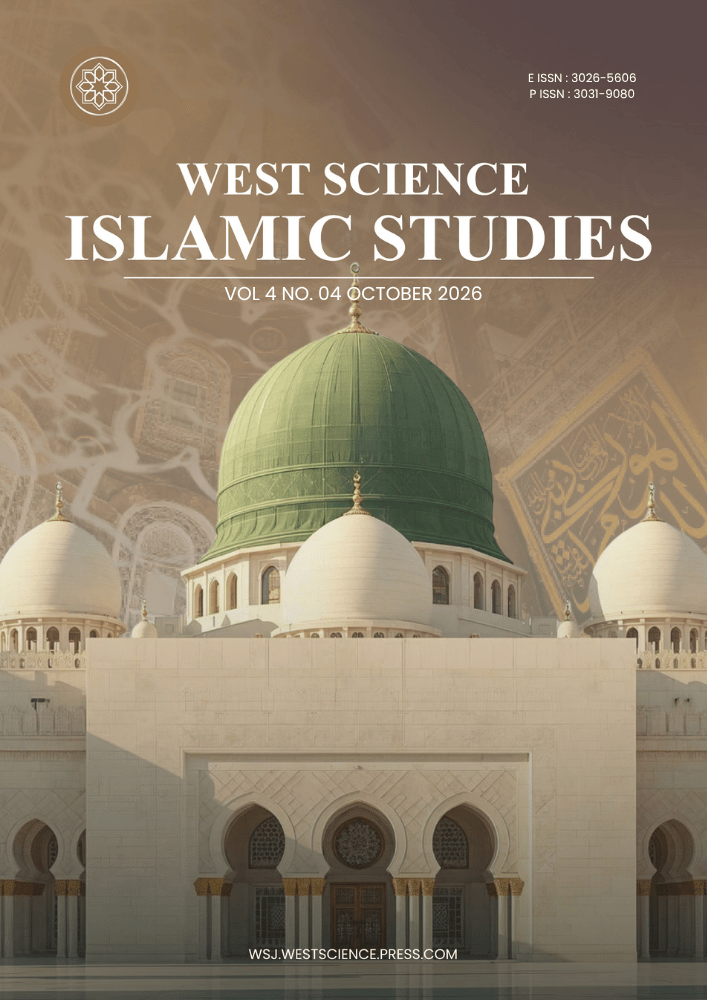
Islamic Ethics in the Digital Era: A Bibliometric Analysis
DOI:
https://doi.org/10.58812/wsiss.v4i04.3198Keywords:
Islamic Ethics, Digital Ethics, Bibliometric Analysis, Artificial Intelligence, VOSviewerAbstract
The rapid advancement of digital technologies has introduced complex ethical challenges that require critical examination through religious and moral perspectives, including Islamic ethics. This study aims to systematically map the intellectual structure, research development, collaborative networks, and emerging thematic trends in scholarly literature concerning Islamic ethics in the digital era. Employing a bibliometric approach, the study utilizes VOSviewer to conduct citation analysis, co-authorship analysis, institutional and country collaboration mapping, keyword co-occurrence analysis, overlay visualization, and density visualization. The findings reveal that Islamic digital ethics constitutes an increasingly interdisciplinary research domain encompassing artificial intelligence, digital communication, Islamic finance, blockchain, and sustainable digital transformation. Citation analysis identifies blockchain, financial technology, and Islamic finance as influential areas of scholarly contribution. The collaboration analysis demonstrates the prominent roles of Indonesia and Malaysia in international research networks, although institutional collaboration remains relatively concentrated. Keyword co-occurrence analysis identifies artificial intelligence, Islamic ethics, digital ethics, social media, and ethical principles as dominant themes. Furthermore, overlay visualization indicates a thematic transition from digital financial applications and communication technologies toward machine learning, digital transformation, and sustainable development. Density visualization confirms the concentration of scholarly attention around artificial intelligence and ethical frameworks while revealing comparatively less developed thematic areas. The study highlights the importance of integrating Islamic ethical principles, particularly trustworthiness, justice, accountability, and public welfare, into contemporary technological governance. These findings contribute to the literature by providing a systematic understanding of the field's intellectual landscape and identifying potential directions for future interdisciplinary research on responsible artificial intelligence, data privacy, algorithmic accountability, and sustainable digital innovation.
References
[1] E. Elmahjub, “Artificial Intelligence (AI) in Islamic Ethics: Towards Pluralist Ethical Benchmarking for AI: E. Elmahjub,” Philos. Technol., vol. 36, no. 4, p. 73, 2023.
[2] F. Ali, K. Bouzoubaa, F. Gelli, B. Hamzi, and S. Khan, “Islamic ethics and ai: An evaluation of existing approaches to ai using trusteeship ethics: Fatima ali,” Philos. Technol., vol. 38, no. 3, p. 120, 2025.
[3] S. H. Wahid, “Exploring the intersection of Islam and digital technology: A bibliometric analysis,” Soc. Sci. Humanit. Open, vol. 10, p. 101085, 2024.
[4] N. Donthu, S. Kumar, D. Mukherjee, N. Pandey, and W. M. Lim, “How to conduct a bibliometric analysis: An overview and guidelines,” J. Bus. Res., vol. 133, pp. 285–296, 2021.
[5] A. S. Sofyan, E. Rusanti, N. Nurmiati, S. Sofyan, R. Kurniawan, and R. E. Caraka, “Islam in business ethics research: a bibliometric analysis and future research agenda,” Int. J. Ethics Syst., 2024.
[6] M. K. Al Faiz, A. K. Hasan, M. Z. Azani, and A. N. AN, “Bibliometric Trends in Research on Islam and Morality: Contextualizing Findings Within Qur’anic Thought,” Iseedu J. Islam. Educ. Thoughts Pract., vol. 9, no. 2, pp. 168–184, 2025.
[7] N. J. van Eck and L. Waltman, “Software survey: VOSviewer, a computer program for bibliometric mapping,” Scientometrics, vol. 84, no. 2, pp. 523–538, 2010, doi: 10.1007/s11192-009-0146-3.
[8] H. Mohamed and H. Ali, “Blockchain, Fintech, and Islamic finance: Building the future in the new Islamic digital economy,” in Blockchain, fintech, and Islamic finance, de Gruyter, 2022.
[9] E. Suandi, H. Herri, Y. Yulihasri, and S. Syafrizal, “An empirical investigation of Islamic marketing ethics and convergence marketing as key factors in the improvement of Islamic banks performance,” J. Islam. Mark., vol. 14, no. 6, pp. 1438–1462, 2023.
[10] R. K. Sari, M. Alfarizi, and M. S. Ab Talib, “Sustainable strategic planning and management influence on sustainable performance: findings from halal culinary MSMEs in Southeast Asia,” J. Model. Manag., vol. 19, no. 6, pp. 2034–2060, 2024.
[11] P. Rahmah Nur Hakim, A. S. Razick, I. Abdullah, M. R. Musfiroh, and S. Sintang, “Contesting sharia and human rights in the digital sphere: media representations of the caning controversy under the qanun jinayat in aceh,” J. Islam. L., vol. 6, p. 206, 2025.
[12] E. Gorian and N. D. Osman, “Digital ethics of artificial intelligence (AI) in Saudi Arabia and United Arab Emirates,” Malaysian J. Syariah Law, vol. 12, no. 3, pp. 583–597, 2024.
[13] M. Abdillah, “Sharia and Politics in the Context of Globalization and Society 5.0,” Ahkam J. Ilmu Syariah, vol. 22, no. 2, 2022.
[14] O. Dastane, E. C.-X. Aw, J. C. Fandos-Roig, and J. Sánchez-García, “Ethical marketing: a review and research agenda,” Mark. Intell. Plan., vol. 44, no. 1, pp. 121–142, 2026.
[15] B. Santoso, “Islamic microfinance branchless banking model in Indonesia,” Intellect. Discourse, 2016.
[16] A. Hindolia, J. Arya, R. Pathak, and A. Kazmi, “Halal B2B marketing in the metaverse: crafting a conceptual framework to pinpoint opportunities and challenges, outlining the agenda for future research,” J. Islam. Mark., vol. 17, no. 2, pp. 610–630, 2026.
[17] M. Y. Chaudhary, “Initial Considerations for Islamic Digital Ethics: MY Chaudhary,” Philos. Technol., vol. 33, no. 4, pp. 639–657, 2020.
Downloads
Published
Issue
Section
License
Copyright (c) 2026 Sintia Permata Sari, Achmad Harristhana Mauldfi Sastraatmadja, Bintang Cahya

This work is licensed under a Creative Commons Attribution-ShareAlike 4.0 International License.














 Facebook
 Instagram
 Twitter
 Youtube
 westscience.journals@gmail.com