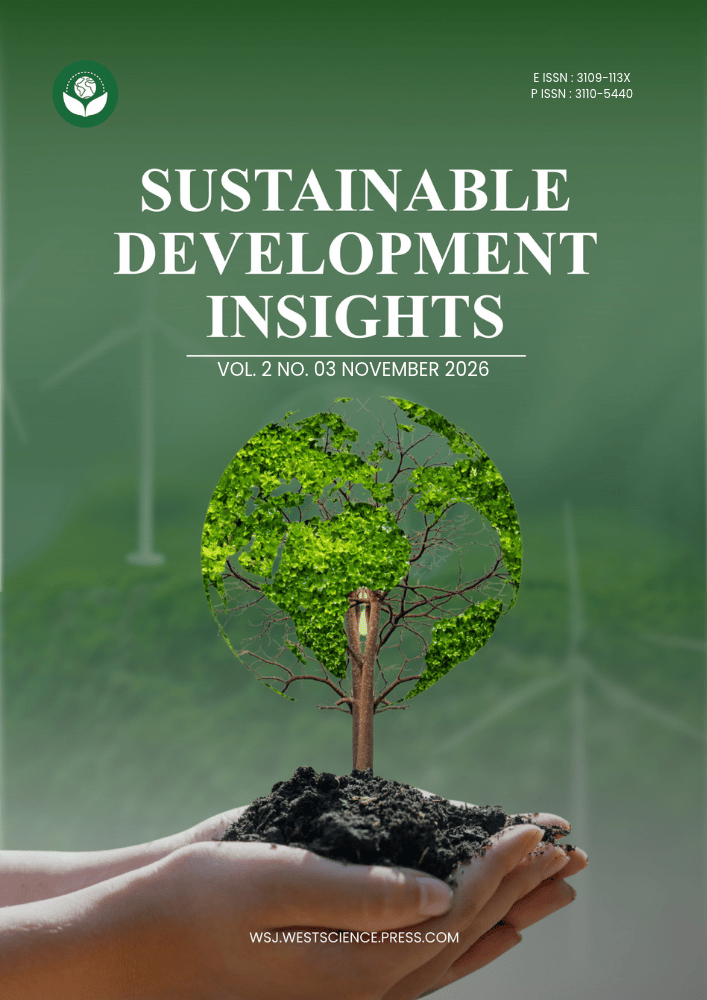
Environmental Impact Assessment of Tuni Coffee Production Using Life Cycle Assessment in West Seram Regency
DOI:
https://doi.org/10.58812/sdi.v2i03.3250Keywords:
Tuni Coffee, Life-Cycle-Informed Assessment, Resource Consumption, Waste Management, Perceived Environmental ImpactAbstract
Environmental sustainability in smallholder coffee production remains a critical concern, particularly in regions where resource management practices and ecological pressures are insufficiently documented. This study examines the associations between resource consumption, energy utilization, waste management, and perceived environmental impacts in Tuni coffee production in West Seram Regency, Indonesia. A quantitative cross-sectional survey involving 85 respondents was conducted using a life-cycle-informed environmental assessment framework. Data were collected through a structured questionnaire and analyzed using multiple linear regression with SPSS version 25. The findings reveal significant negative associations between perceived environmental impacts and resource consumption management, energy utilization management, and waste management. Resource consumption demonstrated the strongest association, while the model explained 22.5% of the variation in perceived environmental impacts. These findings suggest that more efficient resource use, responsible energy management, and improved waste practices are associated with lower perceived environmental pressures. The study contributes to smallholder agricultural sustainability research by extending life-cycle thinking to a locally distinctive coffee production system through a perception-based assessment. The findings provide practical insights for identifying environmental management priorities while emphasizing the need for inventory-based assessments to quantify actual environmental impacts.
References
[1] M. R. Giraldi-Díaz, L. De Medina-Salas, E. Castillo-González, and R. León-Lira, “Environmental Impact Associated with the Supply Chain and Production of Grounding and Roasting Coffee through Life Cycle Analysis,” Sustainability, vol. 10, no. 12, p. 4598, 2018, doi: 10.3390/su10124598.
[2] D. M. Rahmah, A. S. Putra, R. Ishizaki, R. Noguchi, and T. Ahamed, “A Life Cycle Assessment of Organic and Chemical Fertilizers for Coffee Production to Evaluate Sustainability toward the Energy–Environment–Economic Nexus in Indonesia,” Sustainability, vol. 14, no. 7, p. 3912, 2022, doi: 10.3390/su14073912.
[3] A. Irawan, H. Rabemanolontsoa, and B. C. McLellan, “Comprehensive Environmental Impact Analysis of Dry Processing Methods for Specialty Coffee Beans in Bondowoso, Indonesia Using Life Cycle Assessment,” Biomass, vol. 4, no. 3, pp. 843–864, 2024, doi: 10.3390/biomass4030047.
[4] I. Acosta-Alba, J. Boissy, E. Chia, and N. Andrieu, “Integrating diversity of smallholder coffee cropping systems in environmental analysis,” Int. J. Life Cycle Assess., vol. 25, pp. 252–266, 2020, doi: 10.1007/s11367-019-01689-5.
[5] A. Ardiansyah, A. S. Mahulette, and A. K. Kilkoda, “Eksplorasi Keragaman Morfologi dan Karakter Penciri Tanaman Kopi Lokal ‘Tuni’ di Kabupaten Seram Bagian Barat, Maluku,” Agrologia, vol. 15, no. 1, 2026, doi: 10.30598/agrologia.v15i1.24683.
[6] L. S. dos Muchangos, C. Mejia, R. Gupta, S. Sadreghazi, and Y. Kajikawa, “A systematic review of life cycle assessment and environmental footprint for the global coffee value chain,” Environ. Impact Assess. Rev., vol. 111, p. 107740, 2025, doi: 10.1016/j.eiar.2024.107740.
[7] I. O. for Standardization, “Environmental management — Life cycle assessment — Principles and framework,” ISO 14040:2006. International Organization for Standardization, 2006. [Online]. Available: https://www.iso.org/standard/37456.html
[8] C. Chéron-Bessou et al., “Unravelling life cycle impacts of coffee: Why do results differ so much among studies?,” Sustain. Prod. Consum., vol. 47, pp. 251–266, 2024, doi: 10.1016/j.spc.2024.04.005.
[9] J. A. Serna-Jiménez, J. A. Siles, M. de los Á. Martín, and A. F. Chica, “A Review on the Applications of Coffee Waste Derived from Primary Processing: Strategies for Revalorization,” Processes, vol. 10, no. 11, p. 2436, 2022, doi: 10.3390/pr10112436.
[10] K. Usva, T. Sinkko, F. Silvenius, I. Riipi, and H. Heusala, “Carbon and water footprint of coffee consumed in Finland—life cycle assessment,” Int. J. Life Cycle Assess., vol. 25, pp. 1976–1990, 2020, doi: 10.1007/s11367-020-01799-5.
[11] R. Pramulya, T. Bantacut, E. Noor, M. Yani, and M. Romli, “Life Cycle Assessment of Gayo Arabica Coffee Green Bean at Aceh Province,” HABITAT, vol. 33, no. 3, pp. 308–319, 2022, doi: 10.21776/ub.habitat.2022.033.3.29.
[12] S. S. Arya, R. Venkatram, P. R. More, and P. Vijayan, “The wastes of coffee bean processing for utilization in food: a review,” J. Food Sci. Technol., vol. 59, no. 2, pp. 429–444, 2022, doi: 10.1007/s13197-021-05032-5.
[13] Y.-G. Lee, E.-J. Cho, S. Maskey, D.-T. Nguyen, and H.-J. Bae, “Value-Added Products from Coffee Waste: A Review,” Molecules, vol. 28, no. 8, p. 3562, 2023, doi: 10.3390/molecules28083562.
[14] L. van der Feen, P. A. Verweij, W. J. V Vermeulen, C. Montagnon, and F. Sheibani, “Life cycle assessment of Seed-to-Cup specialty coffee cultivated by smallholders in Yemen,” Int. J. Life Cycle Assess., vol. 30, pp. 1761–1775, 2025, doi: 10.1007/s11367-025-02495-y.
Downloads
Published
Issue
Section
License
Copyright (c) 2026 La Ega MS

This work is licensed under a Creative Commons Attribution-ShareAlike 4.0 International License.








 Facebook
 Instagram
 Twitter
 Youtube
 +62 821 1557 5700
 westscience.journals@gmail.com